Best Launch Monitors for Garage Golf
Compare launch monitors by the factor that matters most indoors: whether the device actually fits your garage. This guide covers behind-ball versus beside-ball placement, required depth, software, subscriptions, handedness, useful shot data, and the best pick for each type of home golfer.
The right launch monitor depends on your garage—not the longest feature list.
Our picks by situation
For a first garage setup with enough depth, the Garmin Approach R10 is the most approachable starting point. The Rapsodo MLM2PRO is the stronger mobile-app and video choice. Read our full Rapsodo MLM2PRO review for garage-space requirements, measured spin, club data, video tools, software, subscriptions, and total ownership cost. Golfers deciding between Garmin and Rapsodo should also read our Garmin R10 vs Rapsodo MLM2PRO comparison. The SKYTRAK ST MAX is the current compact premium indoor option for golfers who want detailed ball and club data. Read our full SKYTRAK ST MAX review for garage-space requirements, beside-ball placement, ball and club data, memberships, Course Play, setup, ownership cost, and who should buy it. If you are choosing between SKYTRAK’s beside-ball layout and Rapsodo’s lower-cost video-focused system, see our SKYTRAK ST MAX vs Rapsodo MLM2PRO comparison for room depth, spin, club data, software, memberships, and three-year ownership cost side by side. The Swing Caddie SC300i and PRGR HS-130A are better treated as practice monitors than full simulator systems.
Will the launch monitor fit your garage?
This is the most important comparison on the page. Manufacturer placement guidance can change, so verify the current manual, but these requirements show why two similarly priced launch monitors may fit completely different rooms.
| Launch Monitor | Device Position | Manufacturer Space Guidance | Practical Garage Impact | Best Room Type |
|---|---|---|---|---|
| Garmin Approach R10 | Behind the ball | 6–8 ft behind the tee and at least 8 ft from tee to net | Plan roughly 14–16 ft of tracking depth, plus screen buffer and comfortable golfer clearance | Medium/deep garage |
| Rapsodo MLM2PRO | Behind the ball | 6.5–8.5 ft behind the ball and 8 ft from ball to net | Needs a little more than 14 ft before adding screen buffer; video capture may benefit from extra room | Medium/deep garage |
| SKYTRAK ST MAX | Beside the ball | Uses an approximately 4 × 4 in hitting zone beside the ball; room still must allow a full unrestricted swing | Saves the 6–8 ft often needed behind the hitting area, which can help in shorter rooms | Shallower indoor room |
| Swing Caddie SC300i | Behind the ball | At least 5 ft behind the ball, level with the hitting surface | Less behind-ball space than Garmin or Rapsodo, but it is a practice monitor rather than a full simulator | Practice station |
| PRGR HS-130A | Behind the ball | Follow the current listing/manual for placement and alignment | Compact and simple, but intended for speed and basic feedback—not virtual course play | Small practice area |
Behind-ball devices
Radar-style monitors can be portable and versatile, but the monitor, golfer, ball flight, net, and screen buffer all consume room depth.
Beside-ball devices
Camera-based systems can reduce the space needed behind the golfer, but they require a consistent hitting zone and protected device placement.
The golfer still needs room
A compact monitor does not make a tiny room safe. Ceiling height, backswing clearance, width, and side-miss protection still control the build.
Best launch monitors for garage golf by situation
The Lasso cards below provide the current Amazon image, price, and product link. The garage-fit notes underneath each card are our editorial analysis: who the product fits, how much space it needs, and what could make it the wrong choice.
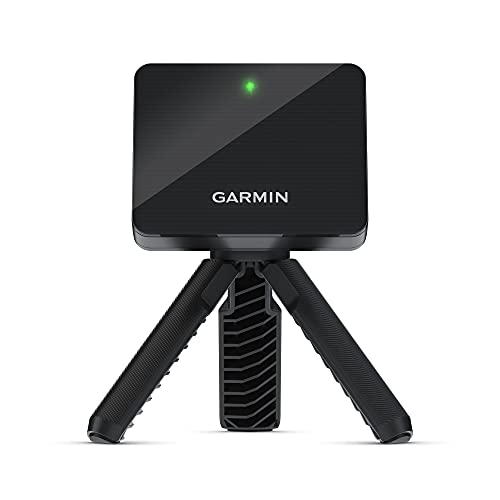
Our top starter pick for garage golfers with enough depth for a radar-based setup. It is portable, simulator-capable, and a strong value for mat-and-net practice without immediately building a premium simulator bay.
A strong choice for golfers who want app-based practice, video feedback, measured shot data, and simulator play. It combines Doppler radar with two cameras and works especially well for golfers who enjoy a mobile-first practice experience.

A premium indoor launch monitor that sits beside the ball, saving the space behind the golfer required by many radar systems. Combines photometric cameras and dual Doppler radar for detailed ball and club data.

A straightforward portable monitor for golfers who want immediate practice feedback without building a full simulator. Its built-in display, voice output, remote control, and optional app make short garage sessions simple and measurable.

A compact and simple option for golfers focused on swing speed, ball speed, smash factor, and estimated distance. It is best treated as a practice and speed-training tool rather than a complete golf simulator.

Garage fit matters more than brand popularity.
Golf Garage Guide does not claim hands-on testing unless it has actually occurred. These recommendations are based on current manufacturer documentation, product specifications, placement requirements, software and membership details, indoor-use practicality, and how each monitor fits into a realistic garage build.
Radar vs camera launch monitors for garage golf
The tracking category affects where the device sits, how much room it needs, whether it can travel to the range, and how easily multiple golfers can use the setup.
Radar and hybrid monitors
Garmin, Rapsodo, Swing Caddie, and PRGR-style devices sit behind the ball and look down the target line.
- Often portable for garage and range use
- Convenient for right- and left-handed golfers
- Require open space behind the hitting area
- May need meaningful ball flight before the net
- Alignment and level setup matter every session
Camera and hybrid photometric monitors
SKYTRAK ST MAX combines photometric cameras with dual Doppler radar while observing the impact area from beside the ball, reducing the device depth behind the golfer.
- Attractive for shorter indoor rooms
- Compact and well suited to dedicated bays
- Need consistent ball placement in the hitting zone
- The device should be protected from shanks and clubs
- Left/right switching may require more width or repositioning
Choose the placement style before choosing the product
A behind-ball monitor can be easier for mixed-handed groups but consumes room depth. A beside-ball monitor can fit a shallower room but needs a protected impact-area position and more thought when players switch sides.
Which launch monitor numbers actually matter?
Beginners usually improve faster by understanding a small set of reliable metrics than by chasing every available number.
Carry distance
Use carry—not total distance—for club gapping, wedges, approach shots, and target practice.
Ball speed
Ball speed helps show whether strike quality improved and whether added swing speed actually created output.
Smash factor
Smash factor compares ball speed with club speed and can make contact work easier to quantify.
Launch angle
Launch angle helps explain low or high flight windows with wedges, irons, and driver.
Spin rate and axis
Spin helps explain trajectory and curvature, but verify whether the monitor measures it and whether special balls are required.
Club path and face data
Valuable for serious swing work, but only worth paying for when you understand how to use the numbers.
The launch monitor is only half the purchase.
Apps, memberships, simulated courses, computer requirements, compatible devices, and special golf balls can change the real cost and experience.
Check before buying
- Which features work without a paid membership?
- Does the app support your phone, tablet, or computer?
- Is virtual course play included or sold separately?
- Are special marked balls required for measured spin?
- Does your desired simulator software support the device?
- Can you export or review historical practice data?
Product-specific examples
- Rapsodo Premium unlocks many advanced analytics, video, ranges, and course features
- RPT balls are required for measured MLM2PRO spin rate and spin axis
- SKYTRAK ST MAX supports game-improvement tools, while memberships unlock additional practice and Course Play features
- SC300i provides simple practice data but does not connect to full simulator apps
- PRGR keeps the experience simple because it is not built around simulation software
Compare three-year cost—not only checkout price
Add the monitor, memberships, software, compatible computer or tablet, special balls, protective case, mat, net or screen, and any display hardware before comparing two options.
Right- and left-handed golfers can change the best choice.
Behind-ball advantage
Radar-style devices stay on the target line behind the ball, so right- and left-handed golfers can often switch without moving the monitor.
Beside-ball planning
A camera unit beside the ball may need repositioning or a wider shared hitting area when players switch handedness.
Offset-hitting tradeoff
Centered layouts are easiest to share. Narrow garages may force an offset position that favors one handedness and increases side-protection needs.
How much should you spend?
Current product prices appear in the Lasso cards. These categories describe the type of experience—not fixed price promises.
Speed and simple metrics
Best for PRGR-style feedback when virtual golf is not the goal.
Built-in display
SC300i-style monitoring adds fast practice data without a complex simulator stack.
Portable app system
Garmin and Rapsodo-style products add simulated play, richer data, and an upgrade path.
Compact hybrid system
SKYTRAK ST MAX can improve indoor fit while combining camera and radar tracking, but it requires a larger total budget.
Garage launch monitor comparison
| Monitor | Best For | Placement | Simulator Play | Subscription / Software Watchout | Main Garage Limitation |
|---|---|---|---|---|---|
| Garmin R10 | Beginner and value simulator builds | 6–8 ft behind ball; 8+ ft ball to net | Yes, app/software dependent | Review current Garmin and third-party software access | Needs meaningful total depth |
| Rapsodo MLM2PRO | Mobile app, video, spin, and simulator practice | 6.5–8.5 ft behind ball; 8 ft ball to net | Yes | Premium membership unlocks many advanced features; RPT balls for measured spin | Depth, compatible device, and ongoing membership cost |
| SKYTRAK ST MAX | Premium compact indoor simulator and serious practice | Beside ball in an approximately 4 × 4 in hitting zone | Yes | Memberships and compatible computer/software requirements | Higher total cost, device protection, and mixed-handed positioning |
| Swing Caddie SC300i | Simple, fast practice feedback | At least 5 ft behind ball | No full simulator-app support | Optional app, but not an E6/virtual-course device | Limited upgrade path into full simulation |
| PRGR HS-130A | Speed training and basic feedback | Compact behind-ball setup | No | Minimal software complexity | Limited data and no virtual golf |
Common launch monitor buying mistakes
Buying before measuring
A popular monitor can be useless if the garage cannot meet its placement and ball-flight requirements.
Ignoring total ownership cost
Memberships, software, computers, special balls, and accessories can exceed the difference between two devices.
Calling every device a simulator
SC300i and PRGR are useful practice monitors, but they do not deliver the same experience as simulator-ready systems.
Overbuying data
Advanced club metrics are valuable only when you understand them and will change practice based on the results.
Exposing the device to shanks
Beside-ball systems and display devices need protection without blocking the tracking area.
Ignoring mixed-handed users
A layout that works perfectly for one right-handed golfer may be frustrating for a family or left-handed guest.
Garage launch monitor FAQs
What is the best launch monitor for most beginner garage golfers?
The Garmin Approach R10 is a practical starting point when the garage has enough depth. It supports measurable practice and simulator-style use without requiring the budget of a premium indoor camera system. The Rapsodo MLM2PRO is the stronger alternative for golfers who prioritize video, app features, and measured spin with compatible RPT balls.
How much room does a Garmin R10 need indoors?
Garmin’s current guidance places the R10 6–8 feet behind the tee, with the tee at least 8 feet from the net. That creates 14–16 feet of tracking depth before adding safe buffer space behind the net or screen and comfortable room for the golfer.
How much room does the Rapsodo MLM2PRO need indoors?
Rapsodo says the unit sits 6.5–8.5 feet behind the ball and the ball should be 8 feet from the net, requiring a little more than 14 total feet. Taller golfers may benefit from additional room for full swing-video capture.
Is the SKYTRAK ST MAX better for a shallow garage?
The beside-ball SKYTRAK ST MAX avoids the 6–8 feet of device space commonly needed behind the golfer by radar-only monitors, which can help in a shallower room. The garage still needs enough depth for safe ball flight and screen buffer, enough width for the golfer’s full swing, a level hitting surface, and a protected position for the launch monitor.
Can the Swing Caddie SC300i run a full golf simulator?
No. Voice Caddie states that the SC300i does not support E6 Connect or other simulator apps. It is best for straightforward practice feedback through its display, voice output, remote, and optional app.
Is the PRGR HS-130A a golf simulator?
No. It is a compact speed and basic-distance feedback tool. It is useful for swing-speed training and simple practice, but it is not designed for virtual-course play.
Do launch monitors require subscriptions?
It depends on the device and features. Basic functions may work without a paid plan, while simulated courses, advanced analytics, video tools, cloud storage, or game-improvement features may require a membership. Check the current plan before buying.
Should I buy a launch monitor before a mat and net?
Plan the full bay first. The monitor placement, hitting surface, ball-to-net distance, golfer position, protection, and display all affect one another. Buying the monitor first can lock you into a layout that does not fit.
Manufacturer references used for space and feature checks
Choose the launch monitor that fits the bay you can actually build.
Start with room depth and golfer clearance. Choose Garmin or Rapsodo when a portable behind-ball simulator fits the garage, consider the SKYTRAK ST MAX when compact premium indoor performance and detailed ball and club data matter, and choose Swing Caddie or PRGR when simple practice feedback matters more than virtual golf.