Best Launch Monitor for Small Indoor Spaces
The best monitor for a tight room is not simply the most accurate or popular model. It is the one whose hitting zone, depth, lighting, software, display, ball requirements, and protection system fit the exact garage, basement, shed, or spare room.
SKYTRAK ST MAX is the strongest overall fit when depth is limited.
It sits beside the ball instead of several feet behind the golfer, which preserves room depth. Read our full SKYTRAK ST MAX review for garage-space requirements, beside-ball placement, ball and club data, memberships, Course Play, setup, ownership cost, and who should buy it. If Rapsodo is the lower-cost alternative you are considering, see our SKYTRAK ST MAX vs Rapsodo MLM2PRO comparison for room depth, measured spin, club data, video, simulator software, memberships, and three-year ownership cost side by side. The tradeoff is a premium price, a defined hitting zone, compatible device and software requirements, and the need to protect a side-mounted unit from clubs and mishits.
Measure around the tracking style—not only the golfer.
Mark the screen or net, ball, mat, full driver swing, launch monitor, required ball flight, rear-device space, side-device zone, display, power, and walking path with painter’s tape.
Best launch monitors for small indoor spaces
The ranking prioritizes real indoor fit first, then tracking usefulness, software path, ease of setup, and price. “Small” can mean short depth or narrow width, so the correct winner changes with the room.
A short room and a narrow room need different monitors.
Short-depth room
Prioritize a beside-ball photometric or near-ball system. Rear radar can consume the depth you need for the golfer and ball flight.
Long, narrow room
A rear radar monitor may fit when the room has sufficient length, target distance, rear-device space, swing width, and side containment.
Shared garage
Prioritize repeatable floor marks, portable equipment, protected storage, fast alignment, safe cables, and a setup that does not block vehicles.
SKYTRAK ST MAX Launch Monitor
ST MAX earns the top position because it tracks from beside the ball, preserving the rear space that radar monitors use. It combines photometric cameras with dual Doppler radar, provides ball and club data, and is designed for indoor or outdoor use.
A premium indoor launch monitor that sits beside the ball, saving the space behind the golfer required by many radar systems. Combines photometric cameras and dual Doppler radar for detailed ball and club data.

Why it fits
No large rear-device zone is required behind the golfer, and the ball is placed in a compact laser-defined area beside the unit.
Watch out for
The side unit needs protection from shanks, clubs, mat-height differences, and traffic. Verify supported devices, software, and memberships.
Our verdict
Best small-room choice when budget allows and the room has adequate swing width, safety clearance, and a protected side-device position.
Rapsodo MLM2PRO Launch Monitor
MLM2PRO combines Doppler radar and cameras with simulator and practice features. It is a compelling value when the room is long enough, but it is not a true short-depth solution.
A strong choice for golfers who want app-based practice, video feedback, measured shot data, and simulator play. It combines Doppler radar with two cameras and works especially well for golfers who enjoy a mobile-first practice experience.

Why it fits
It offers strong simulator and practice value without requiring a premium beside-ball system, provided the room has more than 14 feet of usable length.
Watch out for
Rear placement, phone or tablet support, membership features, compatible balls for certain measured spin functions, and swing-video framing.
Our verdict
Best value here for a garage that is narrow but not short. Measure the full usable depth after net, wall, and golfer clearance.
Garmin Approach R10 Launch Monitor
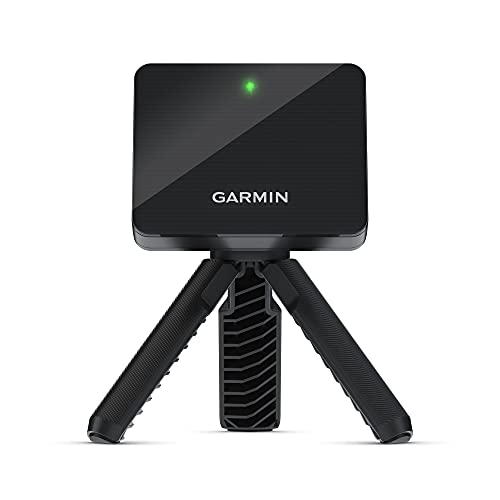
The R10 remains attractive for portability, indoor and outdoor use, and simulator features. It fits only when the room can satisfy its rear-radar geometry.
Our top starter pick for garage golfers with enough depth for a radar-based setup. It is portable, simulator-capable, and a strong value for mat-and-net practice without immediately building a premium simulator bay.
Why it fits
Compact hardware, easy portability, radar operation that is not dependent on bright room lighting, and a useful simulator ecosystem.
Watch out for
The 15-foot room reference can still be tight after screen movement, rear walking clearance, golfer comfort, and wall protection are included.
Our verdict
Choose R10 when portability matters and the tape-measured room passes Garmin’s indoor placement guidance without crowding the golfer.
Swing Caddie SC300i Launch Monitor
SC300i is the easiest recommendation for golfers who want a standalone display, voice output, core swing and ball-flight metrics, and app-based session review without building a complete virtual-golf simulator.
A straightforward portable monitor for golfers who want immediate practice feedback without building a full simulator. Its built-in display, voice output, remote control, and optional app make short garage sessions simple and measurable.

Why it fits
The built-in screen and voice feedback reduce dependence on a TV, projector, gaming computer, or complicated simulator software.
Watch out for
It is a radar practice monitor, not the strongest choice for immersive course play. Verify the current indoor positioning instructions.
Our verdict
Best for a golfer who wants useful practice data in a compact routine and does not need the launch monitor to power a full simulator bay.
PRGR HS-130A Launch Monitor
PRGR belongs in this guide as a simple speed and distance practice tool. It can help with club-speed training and basic feedback, but it should not be confused with a camera-based indoor simulator monitor.
A compact and simple option for golfers focused on swing speed, ball speed, smash factor, and estimated distance. It is best treated as a practice and speed-training tool rather than a complete golf simulator.

Why it fits
Small hardware, simple data, no gaming computer requirement, and an approachable price make it easy to add to a mat-and-net practice area.
Watch out for
Estimated distance and limited metrics cannot replace full ball-flight, club-delivery, video, or simulator-software feedback.
Our verdict
Buy it for speed training and basic practice—not because it is the cheapest way to create a full indoor golf simulator.
Camera vs radar in a small indoor room
Near-ball camera or photometric system
- Preserves space behind the golfer
- Works around a defined hitting zone
- Often strong into a net or screen
- May need controlled lighting and exact mat height
- Side unit requires club and shank protection
Rear Doppler radar system
- Can offer indoor and outdoor flexibility
- Requires verified monitor-to-ball spacing
- Requires verified ball flight to target
- Alignment and metallic interference can matter
- May consume 14–15+ feet of room length
Best small-space launch monitors compared
| Monitor | Placement | Small-room fit | Simulator path | Main limitation | Best for |
|---|---|---|---|---|---|
| SKYTRAK ST MAX | Beside ball | Best for short depth | Strong practice and course-play path | Premium cost, side-device zone, software and membership planning | Premium tight indoor bay |
| Rapsodo MLM2PRO | 6.5–8.5 ft behind ball; 8 ft ball flight | Long, narrow room | Strong value and broad simulator support | More than 14 ft total, mobile-device and membership considerations | Value-focused simulator |
| Garmin Approach R10 | 6–8 ft behind ball; at least 8 ft ball flight | 15-ft room reference | Portable simulator ecosystem | Room depth, alignment, rear clearance, subscription features | Indoor/outdoor portability |
| Swing Caddie SC300i | Radar position behind ball; verify current instructions | Simple practice | Limited compared with full simulator models | Not the best course-play choice | Standalone data and voice |
| PRGR HS-130A | Simple radar practice placement; verify instructions | Budget tool | Not a full simulator | Limited metrics and estimated distance | Speed training |
Compare software, memberships, devices, and balls before checkout.
Supported device
Confirm iPhone, iPad, Android, Windows PC, Mac support, processor, memory, graphics hardware, ports, and operating-system version.
Membership
Separate included basic features from paid practice tools, cloud storage, club data, advanced metrics, course play, and third-party access.
Simulator software
Confirm the exact compatibility, license, subscription, courses, computer requirements, putting support, and connection workflow.
Ball requirements
Some indoor spin features can depend on marked or manufacturer-specific balls. Include replacement-ball cost and screen wear in the plan.
Match the monitor to a net or impact-screen layout.
Launch monitor + golf net + tablet or TV
- Usually lower cost and easier to store
- Works well for data and virtual-range practice
- Avoids projector throw and shadow planning
- Still needs side, ceiling, wall, frame, and floor protection
Launch monitor + impact screen + projector
- Provides the most immersive simulator view
- Needs rear screen buffer and bounceback control
- Requires projector throw, mount, alignment, and lighting
- Consumes more planning space than the monitor alone
Plan the complete small-room system—not only the monitor price.
PRGR or simple monitor
$300–$1,000 total setup range
Budget monitor, mat, net, side protection, and existing phone or tablet.
R10 or MLM2PRO path
$1,200–$3,500 total setup range
Monitor, better mat and net, mobile device, memberships, software, and room protection.
ST MAX net bay
$3,500–$8,000+ total setup range
Premium monitor, high-quality mat, containment, computer or tablet, software, display, and finished room protection.
Screen + projector
$5,000–$15,000+ total setup range
Monitor, enclosure, screen, projector, computer, mat, turf, protection, power, and installation.
Small indoor launch monitor buying mistakes
Calling every garage “small”
A short room, narrow room, low ceiling, offset bay, and shared garage create different constraints.
Using total dimensions instead of usable dimensions
Door tracks, storage, screen movement, walls, net depth, walking clearance, and golfer position reduce the usable room.
Buying radar before checking depth
The advertised hardware size is irrelevant when the device needs several feet behind the ball and a long flight window.
Ignoring the side-unit danger zone
A beside-ball monitor saves depth but requires a stable level mat and protection from clubs, balls, feet, and traffic.
Comparing only hardware prices
Memberships, software, computer, tablet, marked balls, courses, adapters, and room upgrades affect the real cost.
Assuming every metric is measured
Read which metrics are directly measured, calculated, estimated, app-only, ball-dependent, or membership-dependent.
Forgetting both handednesses
Side-mounted monitors and offset hitting areas can require repositioning or a wider protected bay for opposite-handed golfers.
Ignoring the mat height
Camera or near-ball systems can depend on the unit and ball being level, while mat seams can affect stance and alignment.
Skipping a progressive test
Confirm containment and reliable reads with chips and short irons before driver-speed practice.
Indoor fit came before popularity.
Golf Garage Guide does not claim hands-on product testing unless it has actually occurred. This ranking uses current manufacturer setup guidance, tracking position, room geometry, hitting zone, indoor and outdoor flexibility, useful data, software path, device requirements, membership considerations, display options, and the role each product can honestly fill.
Related garage golf guides
Official manufacturer references used for the update
- SKYTRAK ST MAX official product specifications
- SKYTRAK ST MAX quick-start and hitting-zone setup
- SKYTRAK ST MAX user guide and minimum unobstructed area
- Rapsodo MLM2PRO official indoor spacing FAQ
- Garmin Approach R10 official indoor placement guidance
- Voice Caddie SC300i official product metrics
- PRGR HS-130 official product family information
Best launch monitor for small indoor spaces FAQs
What is the best launch monitor for a short indoor room?
A near-ball or beside-ball system is usually easier because it does not require several feet behind the golfer. SKYTRAK ST MAX is our top current pick when its side-mounted hitting zone, width, safety clearances, device requirements, and price fit the room.
What is the best launch monitor for a long, narrow garage?
Rapsodo MLM2PRO or Garmin Approach R10 can be strong options when the room passes the exact rear-device and ball-flight spacing. MLM2PRO calls for a little more than 14 feet total, while Garmin lists a room at least 15 feet long for R10 indoor placement.
Does SKYTRAK ST MAX need space behind the golfer?
It sits beside the ball, preserving rear depth. The golfer still needs full swing clearance, and the official ST MAX user guide shows a 10-foot by 10-foot minimum unobstructed area with ceiling height varying by golfer and club.
Can Garmin R10 work in a small garage?
Yes when the usable room meets Garmin’s current indoor placement guidance: at least 15 feet long, with the R10 6–8 feet behind the ball and the ball at least 8 feet from the net or screen. Additional comfort and safety clearance may require more room.
Can Rapsodo MLM2PRO fit indoors?
Yes. Rapsodo says it needs 8 feet from ball to net plus 6.5–8.5 feet behind the ball, with taller golfers potentially needing more rear distance for swing video.
Do I need a projector?
No. A monitor can display data and software on a phone, tablet, laptop, monitor, or protected TV. A projector adds immersion but also adds throw distance, mounting, lighting, screen, and alignment requirements.
Is SC300i a full golf simulator?
It is best treated as a portable practice monitor with a built-in display, voice output, and core swing and ball-flight metrics. Golfers focused on immersive course play should compare simulator-oriented monitors and software.
Is PRGR enough for indoor practice?
It can be useful for club speed, ball speed, smash factor, and estimated distance practice. It is not a substitute for full ball-flight, club-delivery, shot-shape, video, and simulator-course feedback.
Which data matters most indoors?
Start with carry distance, ball speed, launch angle, spin, start direction, and dispersion. Add club speed, smash factor, club path, face angle, attack angle, and face-to-path when those metrics match your practice goals and you understand how to use them.
Should I buy the monitor before the mat and net?
Choose the monitor and room geometry together, but do not practice until the mat, primary containment, side protection, frame protection, floor, and display placement are safe for real golf balls.
Buy for the room geometry first.
Choose ST MAX when short depth is the main constraint and a protected side-mounted system fits. Choose MLM2PRO or R10 when the room is long enough for rear radar. Choose SC300i or PRGR when simple feedback matters more than immersive simulation. Then verify the current manual, software, device, membership, and safety requirements before checkout.