Best Golf Nets for Garage Practice
A golf net is one of the most important safety pieces in a garage golf setup. The right net catches real golf balls, protects your garage, gives you confidence to practice indoors, and makes a simple mat-and-net station much more useful. The wrong net can sag, tip over, wear out, miss side shots, or create dangerous bounceback.
The best golf net for garage practice
The best golf net for garage practice is large enough to catch normal shots and mishits, strong enough for real golf balls, stable enough not to tip or slide, and deep enough to absorb ball speed without sending balls back toward the golfer. For most garage golfers, a wider net with side protection is safer than a small target-style net.
Before choosing a net, use the garage golf simulator dimensions guide to measure the full frame, golfer, mat, launch-monitor, and rear-buffer zones. Pair the final choice with the garage golf mat guide, then use the complete simulator buying guide if the practice station will eventually become a full simulator.
Best golf nets for garage practice
These four choices cover the clearest garage use cases: a budget starter net, a portable return-style upgrade, a premium long-term practice net, and a cage for more complete side and overhead containment. The Lasso cards show current Amazon images and prices. Confirm the exact size and included accessories before ordering.
GoSports Practice Hitting Net
Best for a first mat-and-net station when price, simple setup, and a wide target matter most.
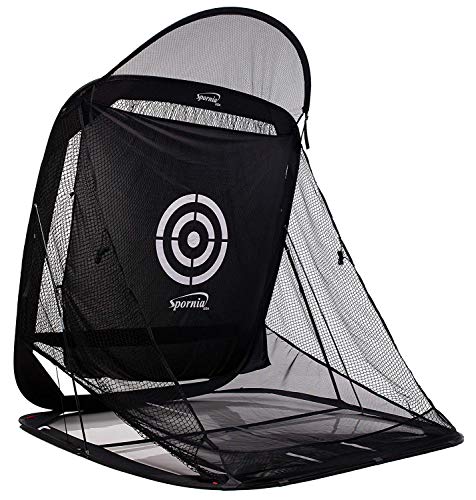
Spornia SPG-7
Best for a shared garage that needs a more polished net with automatic return and easier storage.
The Net Return Pro Series
Best for frequent practice and a durable return-style net that feels like part of a permanent hitting station.
GoSports Range Cage 10 × 8
Best when side misses, high shots, walls, tools, storage, or nearby valuables make broader containment the priority.
| Net | Best For | Format | Strongest Reason to Buy | Main Watchout |
|---|---|---|---|---|
| GoSports Practice Hitting Net | Starter garage practice | Portable bow-frame net; listing may offer multiple sizes | Wide, straightforward entry option | Side and overhead protection may need to be added |
| Spornia SPG-7 | Shared garages and regular practice | 7 × 7 × 7 ft return-style net with roof attachment | Automatic ball return and foldable storage | Still measure the entire depth and add side extensions where needed |
| The Net Return Pro Series | Frequent long-term practice | 8 ft wide × 7 ft 6 in high Pro Series return net | Premium aluminum-frame practice station | Side barriers and complete packages can be separate purchases |
| GoSports Range Cage 10 × 8 | More complete garage containment | 10 × 8 ft cage-style target area | Greater side and overhead coverage than a flat net | Requires substantially more floor and ceiling clearance |
A budget-friendly practice net for golfers building their first garage mat-and-net station. It is a practical starting point for basic indoor practice and portable launch-monitor use, but buyers should confirm the selected size and plan additional protection for side misses and high shots.

A portable pop-up practice net for shared garages where the hitting station may need to be set up and stored between sessions. Its return-style design and added coverage make it a stronger garage upgrade than a basic starter net, although the full footprint and surrounding miss protection still need to be measured.
A premium return-style golf net for frequent garage practice and more permanent hitting stations. It is designed for golfers who want a durable, polished setup with automatic ball return, but buyers should confirm the current model dimensions and whether side barriers are included or sold separately.

A cage-style golf net for garage golfers who want more side and overhead containment than a standard flat practice net. It is especially useful near walls, tools, storage, or other vulnerable areas, but the entire frame depth, width, and ceiling clearance must be measured before ordering.

Why your garage golf net matters so much
In a garage golf setup, the net is not just a target. It is the main safety barrier between a real golf ball and your garage wall, garage door, car, windows, tools, shelves, people, and pets. A net that is too small or too weak can make indoor practice risky.
Ball containment
The net needs to catch regular shots, poor contact, pushes, pulls, toe shots, heel strikes, and the occasional ugly miss.
Garage protection
A good net helps protect drywall, windows, garage doors, cars, storage shelves, and anything else near the practice zone.
Practice confidence
You will practice better when you trust the net. If you are afraid of missing it, your swing will change.
The net is a safety purchase, not just a golf accessory
A cheap or undersized net may seem fine until one hard shot, shank, or ricochet exposes the weak point. For garage practice, safety and coverage matter more than saving a few dollars upfront.
Best types of golf nets for garage practice
Different garage setups need different types of nets. The right choice depends on how much space you have, whether the garage is shared, whether you want portability, and whether you are building a simple practice area or a future simulator setup.
Freestanding golf practice net
A freestanding net is usually the easiest way to start garage practice. It can sit behind your mat and catch shots without requiring a full simulator enclosure.
- Simple to set up
- Works with a hitting mat
- Can be moved or stored
- Good for no-projector setups
Foldable or portable net
A foldable net is useful if the garage still needs to be used for parking, storage, workouts, tools, bikes, or other projects.
- Good for shared garages
- Easy to pack away
- Lower commitment than a permanent setup
- Needs consistent setup each time
Net with side barriers
A net with side panels or added side netting is safer for garage use because it helps catch mishits that do not fly straight into the center.
- Better for shanks and side misses
- Protects walls and storage
- Good for real golf balls
- Takes more width
Permanent net bay or enclosure
A permanent net bay is best for dedicated garage golf spaces where you want a cleaner, safer, more finished indoor practice area.
- Best long-term setup
- Can include side and top protection
- Works well with launch monitors
- Less portable and more expensive
What size golf net is best for a garage?
The best golf net size depends on your garage width, ceiling height, distance from the mat, and how much side protection you need. In general, bigger is safer. A small net may catch perfect shots, but garage practice needs protection for imperfect shots.
Compact practice
A small net may work for controlled wedge shots or tight spaces, but it usually leaves less margin for driver, longer clubs, and mishits.
Better for garages
A medium net gives more confidence and coverage for normal iron practice, especially when paired with side protection.
Best for full swings
A wider net, cage, or enclosure is usually best for full-speed garage practice because it gives more protection against missed shots.
Golf net safety, side protection, and mishits
The main mistake people make with garage golf nets is assuming every shot will go straight into the middle. It will not. A safe garage setup needs protection for shanks, pulls, pushes, pop-ups, low bullets, bounceback, and ricochets.
Protect against these misses
- Shanks into the side wall
- Toe shots and heel shots
- High wedge shots or pop-ups
- Low shots into the frame or floor
- Pushes and pulls that miss the center
- Balls that rebound from hard surfaces
Safety upgrades to consider
- Side netting or curtains
- Wall padding in danger zones
- Ceiling netting near wedge areas
- Frame padding on exposed poles
- Enough room behind the net to absorb shots
- Removing cars and fragile storage from the danger zone
Side protection is not optional for many garage setups
A net directly in front of you may protect the center wall, but it may not protect the side walls, windows, tools, storage shelves, or vehicles. If you are hitting real balls, plan for side misses.
How to reduce golf net bounceback
A good net should absorb the ball instead of firing it back. Bounceback can happen when the net is too tight, too shallow, too close to a wall, or backed by a hard surface. The net needs room to move and slow the ball down.
Give the net depth
A deeper net or net with slack can absorb ball speed better than a tight, flat surface.
Avoid hard backing
Do not place the net directly against drywall, plywood, concrete, a garage door, or metal shelving.
Test gradually
Start with soft swings and short irons before hitting full-speed driver shots into a new net setup.
Best garage layout for a golf net
The best garage net layout gives you room to swing, enough distance to the net, side protection for mishits, and a safe place for your mat, launch monitor, display, clubs, balls, and storage.
Basic garage mat-and-net setup
The golfer hits from a stable mat into a net with enough width, depth, and side protection to contain real golf balls.
Mat placement
The hitting mat should sit where you can swing freely without hitting the ceiling, walls, garage door hardware, or storage.
Net placement
The net should sit far enough from hard surfaces to absorb shots and prevent balls from slamming into the wall behind it.
Launch monitor placement
Leave the required space for your launch monitor. Some units need space behind the ball, while others sit beside the hitting area.
Golf net vs impact screen for garage practice
A golf net and an impact screen can both work in a garage, but they solve slightly different problems. A net is usually simpler and cheaper. An impact screen is better for a projector simulator. Many golfers start with a net and upgrade to a screen later.
| Option | Best For | Pros | Cons | Best Choice |
|---|---|---|---|---|
| Golf net | Simple garage practice | Affordable, portable, easy to use, good for mat-and-net setups | Less immersive than a projected simulator | Best Starter |
| Impact screen | Projector simulator setups | Allows simulator image projection and a more finished look | Needs tension, buffer space, frame planning, and bounceback control | Best Simulator |
| Net bay or enclosure | Dedicated garage golf spaces | Better containment, cleaner setup, strong long-term option | Takes more room and usually costs more | Best Long-Term |
Garage golf net comparison
| Net | Best For | Coverage Style | Storage | Upgrade Path | Best Use |
|---|---|---|---|---|---|
| GoSports Practice Hitting Net | First garage setup | Wide flat/bow-frame net | Portable | Add monitor, shank net, and better mat | Best Budget |
| Spornia SPG-7 | Shared garage and regular use | Deep return net with roof attachment | Folds for storage | Add side extensions, mat, and launch monitor | Best Portable |
| The Net Return Pro Series | Frequent long-term practice | Premium automatic-return net | Portable but more substantial | Add barriers, turf, TV, or simulator screen | Best Premium |
| GoSports Range Cage 10 × 8 | Broader garage containment | Side and overhead cage coverage | Largest footprint | Add compatible screen and projector later | Best Coverage |
Golf net buying checklist for garage practice
Before buying a golf net, think through your actual garage layout and how you plan to practice.
Is it big enough?
Check width, height, depth, and whether it can catch your normal misses.
Can it handle real balls?
Make sure the net is intended for real golf ball impact and your expected swing speed.
Will it stay put?
The frame should not tip, slide, collapse, or shift during normal practice.
Does it protect the garage?
Plan for side misses, bounceback, frame ricochets, ceiling shots, and nearby storage.
Golf net mistakes to avoid in a garage setup
Buying too small
A small net may look fine until one shank, push, pull, or thin shot misses the center.
Ignoring side protection
The main net does not always protect side walls, windows, cars, tools, shelves, or storage bins.
Putting it against a wall
A net placed directly against a hard wall may not absorb shots properly and can increase rebound risk.
Testing with driver first
Start with controlled swings and short irons before hitting full-speed driver into a new setup.
Leaving cars nearby
Vehicles should be outside the danger zone unless you are completely confident the setup contains all shots.
Skipping routine inspections
Check the net for wear, holes, weak spots, frame movement, and loose connections before regular practice.
Best golf net setup for most garage golfers
For most garage golfers, the best setup is a quality hitting mat, a wide and durable golf net, side protection, enough space behind the net, a clean garage floor, and a safe display or launch monitor position outside the ball path.
Stable hitting surface
Use a mat that keeps your stance secure and does not slide on concrete.
Wide coverage
Choose enough width and height for full swings and normal mishits.
Extra protection
Add side netting or curtains if walls, windows, cars, or storage are nearby.
Room to absorb
Keep the net from sitting directly against hard surfaces whenever possible.
A garage net must be judged by real misses—not only center strikes.
Golf Garage Guide does not claim hands-on product testing unless it has actually occurred. These recommendations are based on current manufacturer documentation, listed dimensions, containment style, side and overhead coverage, ball-return design, storage needs, garage footprint, accessory requirements, upgrade potential, and whether the net remains useful with a mat and launch monitor.
Related garage golf guides
Use these guides to match the net to the room, mat, protection plan, and future simulator path.
Best golf nets for garage practice FAQs
What is the best golf net for garage practice?
The best golf net for garage practice is large, durable, stable, and safe enough to catch real golf balls and common mishits. For most golfers, a wider net with side protection is better than a small target net.
Can you use a golf net in a garage?
Yes, you can use a golf net in a garage if you have enough swing space, safe ball containment, wall protection, ceiling clearance, and a net designed for real golf ball impact.
Do I need side netting for garage golf?
Side netting is strongly recommended if you are hitting real golf balls indoors. It helps protect against shanks, pushes, pulls, ricochets, and side misses.
Is a golf net better than an impact screen?
A golf net is usually better for simple, affordable garage practice. An impact screen is better if you want a projector simulator. Many golfers start with a net and upgrade to a screen later.
How do I stop a golf net from bouncing balls back?
Give the net enough depth and slack to absorb the ball, avoid placing it directly against a hard wall, and test gradually before hitting full-speed shots.
What should I put behind a golf net in the garage?
Ideally, leave buffer space behind the net. If you need extra protection, use soft backing such as netting, curtains, or padding rather than exposed hard surfaces.
Should I buy a golf net or a full simulator enclosure?
Buy a golf net if you want the simplest and easiest garage practice setup. Choose a full simulator enclosure if you are ready for a projector, impact screen, more permanent footprint, and a larger garage commitment.
Manufacturer references used for specification checks
- GoSports 10 × 7 ft portable practice-net details
- Spornia SPG-7 dimensions, included accessories, automatic return, and storage information
- The Net Return Pro Series official product information
- The Net Return Pro Package dimensions and included-accessory reference
- GoSports Range Cage 10 × 8 ft official product reference
- GoSports shank-net attachment and side-miss coverage reference
Buy the net for safety first, convenience second.
A good garage golf net should make you feel confident hitting indoors. Choose enough size, strength, depth, and side protection to handle real practice, not just perfect shots into the center.