Best Budget Launch Monitors for Garage Practice
The best budget launch monitor is not automatically the cheapest device. It is the lowest-cost option that fits your garage, produces the feedback you will actually use, and does not force you into unexpected space, software, subscription, computer, ball, or accessory costs.
Rapsodo MLM2PRO offers the strongest budget simulator path.
MLM2PRO is our top value pick for golfers who want practice data, video, measured spin features, and simulator software—provided the garage has the required rear-device and ball-flight depth. Garmin Approach R10 is the better portable alternative. Swing Caddie SC300i is the better simple practice monitor, while PRGR HS-130A is the lowest-cost speed and distance tool.
Price the complete first year—not only the hardware.
Write down the monitor, device, software, membership, courses, marked balls, charging, adapters, net or screen, mat, side protection, computer, TV or projector, and any room work required to make the monitor usable.
Best budget launch monitors for garage practice
The ranking prioritizes total value, indoor usefulness, practice role, simulator path, setup burden, ongoing cost, and whether the product honestly delivers the experience a buyer expects.
“Budget” depends on what you expect the monitor to do.
Speed tool
Measures speed-related practice feedback and estimated distance without trying to recreate complete ball flight or course play.
Standalone monitor
Adds a screen, voice, more metrics, app history, and structured practice without a projector or gaming computer.
Portable radar
Adds virtual golf and broader software options but consumes room depth and can add membership or software costs.
Richer simulator monitor
Costs more upfront but can reduce the chance that you replace an entry monitor after wanting spin, video, shot shape, or courses.
Rapsodo MLM2PRO Launch Monitor
MLM2PRO is the strongest overall value for a golfer who wants more than basic distance feedback. Its radar-and-camera system supports practice video, measured spin features, club-data development, and a broad simulator-software path.
A strong choice for golfers who want app-based practice, video feedback, measured shot data, and simulator play. It combines Doppler radar with two cameras and works especially well for golfers who enjoy a mobile-first practice experience.

Why it wins
It provides the clearest path from measured practice to simulator play among these budget-focused picks.
Hidden costs to check
Premium membership, simulator software, supported mobile device, marked balls, replacement balls, and future PC requirements.
Our verdict
Best value when you have a little more than 14 feet of usable room length and know you want video, richer data, and virtual golf.
Garmin Approach R10 Launch Monitor
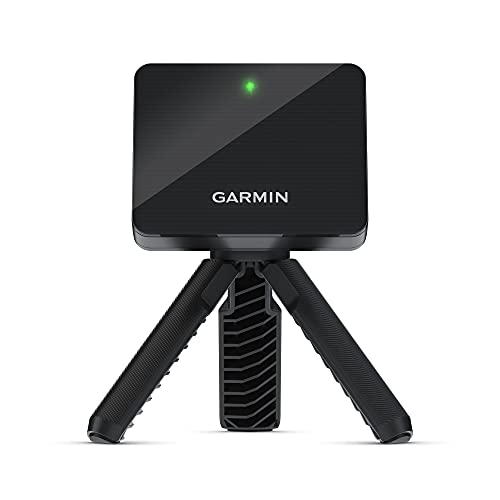
Garmin R10 remains a strong portable value for golfers who want one compact monitor for garage practice, the range, and simulator software. Its greatest limitation indoors is not hardware size—it is the required room geometry behind and in front of the ball.
Our top starter pick for garage golfers with enough depth for a radar-based setup. It is portable, simulator-capable, and a strong value for mat-and-net practice without immediately building a premium simulator bay.
Why it fits
Compact hardware, indoor and outdoor portability, more than a dozen golf metrics, and a well-established simulator ecosystem.
Hidden costs to check
Garmin Golf membership, third-party simulator subscriptions, compatible phone or tablet, marked alignment, and enough garage depth.
Our verdict
Best portable alternative when the garage passes Garmin’s official indoor setup guidance and outdoor use matters.
Swing Caddie SC300i Launch Monitor
SC300i is the cleanest choice for a golfer who wants useful numbers without turning the garage into a software project. Its built-in display and voice output let you practice without mounting a TV, buying a projector, or running course-simulation software.
A straightforward portable monitor for golfers who want immediate practice feedback without building a full simulator. Its built-in display, voice output, remote control, and optional app make short garage sessions simple and measurable.

Why it fits
Standalone feedback keeps the setup simple and works well for club gapping, wedges, speed and distance practice.
What it does not replace
It is not the strongest choice for immersive course play, full shot-shape visualization, or a premium simulator-software build.
Our verdict
Best value for golfers who care more about repeatable practice than entertainment and want fewer ongoing costs.
PRGR HS-130A Launch Monitor
PRGR belongs at the lowest-cost end of the list because it gives simple speed and estimated-distance feedback without requiring a simulator computer, projector, course library, or complicated app workflow.
A compact and simple option for golfers focused on swing speed, ball speed, smash factor, and estimated distance. It is best treated as a practice and speed-training tool rather than a complete golf simulator.

Why it fits
Minimal setup and low ownership complexity make it easy to add measurable feedback to a mat-and-net practice station.
What it cannot tell you
It does not provide complete launch, spin, direction, curve, dispersion, club-delivery, video, or course-simulation feedback.
Our verdict
Buy it for speed, smash and estimated-distance practice—not because it is the cheapest full simulator. It is not a full simulator.
Practice monitor versus simulator launch monitor
Choose SC300i or PRGR when:
- You mainly want speed, carry, smash, gapping, wedge or consistency feedback.
- You do not need projected courses or a gaming computer.
- You prefer a device that gives feedback quickly with fewer accounts and subscriptions.
- You want to keep the complete garage setup compact and inexpensive.
Choose MLM2PRO or R10 when:
- You want virtual golf, richer visualization, simulator software, or a future projected bay.
- You are willing to manage apps, compatible devices, memberships and software.
- The garage has the required rear-device and ball-flight depth.
- You will use the product indoors and outdoors or with multiple practice modes.
Budget radar monitors can become expensive when the room does not fit.
Measure usable depth
Subtract net or screen depth, screen movement, ball-to-target distance, monitor-to-ball distance, golfer clearance, rear walking room, wall protection and garage-door hardware.
Protect the monitor zone
Rear radar devices need stable alignment and protection from feet, children, pets, storage and vehicles. Side devices save depth but create a different club and shank danger zone.
Price the room correction
Moving the ball, replacing a net, rebuilding a mat platform, adding lighting or buying a different monitor can cost more than choosing the correct tracking geometry first.
Budget launch monitors compared by real ownership value
| Monitor | Best role | Indoor space burden | Software path | Ongoing-cost risk | Best buyer |
|---|---|---|---|---|---|
| Rapsodo MLM2PRO | Best overall budget simulator value | More than 14 ft total; rear device plus ball flight | Strong practice, video and simulator path | Higher | Golfer who wants data and virtual golf |
| Garmin Approach R10 | Best portable budget simulator | Official 15-ft room-length reference | Garmin and third-party simulator ecosystem | Moderate to higher | Indoor and outdoor golfer |
| Swing Caddie SC300i | Best simple practice monitor | Rear radar placement; verify current instructions | App review rather than complete simulator focus | Lower | Golfer focused on gapping and consistency |
| PRGR HS-130A | Best ultra-budget speed tool | Simple radar practice placement; verify instructions | No complete simulator path | Lowest | Speed-training and basic-feedback buyer |
The cheap launch monitor can become the expensive setup.
Memberships
Separate included basic use from premium metrics, video storage, courses, club data, third-party access and renewal pricing.
Device requirements
A gaming PC, compatible tablet or newer phone can cost more than the difference between two launch monitors.
Simulator licenses
Check one-time licenses, annual subscriptions, course packs, multiplayer, putting, operating-system and graphics requirements.
Setup corrections
A larger net, new mat, marked balls, lighting, wall padding, side panels, adapters and protected cables change the real budget.
Which launch-monitor data is worth paying for?
Core practice data
- Carry distance
- Ball speed
- Launch angle
- Spin when accurately available
- Start direction and dispersion
Useful club feedback
- Club speed
- Smash factor
- Attack angle
- Club path
- Face angle and face-to-path
Know the data source
- Directly measured
- Calculated from measured inputs
- Estimated from assumptions
- Available only with specific balls
- Locked behind a membership or app
Skip the projector first.
Mat + net + phone
The least complicated simulator-oriented setup uses a safe mat and net with the monitor’s mobile app.
Mat + net + tablet
A larger mobile display can improve practice visibility without adding projector throw, screen image, mount and lighting problems.
Mat + net + protected TV
A side or rear TV can create a finished practice station when it is protected from shanks, clubs, ricochets and walking traffic.
Choose the monitor inside the setup you can actually finish.
PRGR practice station
$300–$1,000 broad setup range
PRGR-style speed tool, basic mat, safe net, side protection and an existing phone used for video or notes.
SC300i net bay
$700–$2,000 broad setup range
Standalone practice monitor, better mat and net, flooring, side protection, lighting and storage.
R10 or MLM2PRO bay
$1,500–$4,000 broad setup range
Simulator monitor, quality mat and net, tablet or existing computer, membership, software and improved room protection.
Screen-and-projector bay
$4,000–$10,000+ broad setup range
Monitor, enclosure, impact screen, projector, computer, software, mat, turf, lighting, padding and installation.
Budget launch monitor mistakes to avoid
Buying the cheapest category
A speed tool, practice monitor and simulator monitor solve different problems. The cheapest product may not provide the experience you expect.
Ignoring room depth
Rear radar placement and ball-flight requirements can make an affordable monitor unusable in a short garage.
Forgetting renewals
Memberships, software, course packs, cloud features and premium data can change the first-year and long-term cost.
Assuming every metric is measured
Estimated distance, calculated spin, app-derived club data and marked-ball metrics are not interchangeable.
Buying a computer too late
A simulator program may require a different operating system or graphics card than the device you already own.
Overlooking the mat
A poor mat can slide, hurt joints, create height problems and make the launch monitor harder to align.
Skipping side protection
A launch monitor does not contain shanks, high misses, frame strikes or floor ricochets.
Buying only for entertainment
Virtual golf is valuable when you will use it, but it does not replace a structured practice routine.
Hard-coding sale prices
Retail prices change. Use live affiliate cards and compare roles, requirements and ownership costs in the article.
Total value came before the lowest sticker price.
Golf Garage Guide does not claim hands-on product testing unless it has actually occurred. The ranking considers product role, indoor placement, useful metrics, simulator path, portability, supported devices, memberships, software, balls, extra hardware, room changes, upgrade risk and whether the buyer is likely to outgrow the device.
Related garage golf guides
Official manufacturer references used for this update
Best budget launch monitors for garage practice FAQs
What is the best budget launch monitor for a garage simulator?
Rapsodo MLM2PRO is our top overall value when the garage has enough depth and the golfer wants practice video, measured spin features and a broad simulator path. Garmin R10 is the stronger portable alternative.
What is the cheapest useful launch monitor?
PRGR HS-130A can provide useful club speed, ball speed, smash factor and estimated-distance feedback. It is a speed and practice tool rather than a complete simulator monitor.
Which budget launch monitor has the lowest ongoing cost?
A standalone practice monitor such as SC300i or a simple speed tool such as PRGR can have fewer software and membership costs than simulator-oriented models. Verify current app, accessory and replacement costs before buying.
Can Garmin R10 work in a garage?
Yes when the usable room meets Garmin’s indoor guidance: at least 15 feet long, with the monitor 6–8 feet behind the ball and the ball at least 8 feet from the net or screen. Additional comfort and safety clearance may require more space.
How much room does Rapsodo MLM2PRO need indoors?
Rapsodo states that a little more than 14 total feet is needed: 8 feet from the ball to the net and 6.5–8.5 feet behind the ball. Taller golfers may need more rear distance for swing-video capture.
Do I need a projector with a launch monitor?
No. A phone, tablet, laptop, monitor or protected TV can display shot data and simulator software. Skipping the projector is one of the easiest ways to control the first-stage garage setup cost.
Is SC300i a full golf simulator?
It is best treated as a portable practice launch monitor with a built-in display, voice output and core swing and ball-flight metrics. Golfers focused on immersive course play should compare simulator-oriented monitors.
What hidden costs should I check?
Check memberships, simulator software, course packs, compatible devices, marked balls, computer requirements, adapters, charging, cases, subscriptions, net or screen upgrades and room-protection changes.
Should a beginner buy a launch monitor?
A launch monitor can help a beginner when the practice plan emphasizes contact, carry, speed, start direction, dispersion and progress rather than chasing every number after every swing.
Should I buy the launch monitor before the net and mat?
Choose the monitor and room geometry together, but do not practice until the hitting surface, primary containment, side protection, frame protection, wall protection and display placement are safe for real golf balls.
Buy the lowest-cost monitor that fully matches your practice goal.
Choose MLM2PRO for the strongest budget simulator path, Garmin R10 for portability, SC300i for simple standalone practice, and PRGR for speed and estimated-distance feedback. Then add the full first-year cost, verify the exact room spacing, and confirm which features are measured, calculated, ball-dependent or membership-dependent.