Garmin Approach R10 Review for Garage Golf
The Garmin Approach R10 remains one of the most accessible ways to add launch data and virtual golf to a garage. This review explains the room it actually needs, how indoor radar affects spin and distance, which software costs extra, and who should buy it instead of a beside-ball launch monitor.
Is the Garmin Approach R10 worth it for a garage?
Yes—for the right garage. The Garmin Approach R10 is a strong value for golfers who want portable launch data, virtual rounds, outdoor range use, and an upgradeable garage simulator without paying premium launch-monitor prices. It is especially attractive for a mat-and-net setup that displays results on a phone, tablet, TV, or projector.
The biggest limitation is not the device’s physical size. It is the amount of clear radar space the R10 needs behind the ball and between the ball and net. Garmin recommends placing the unit 6–8 feet behind the tee and keeping the ball at least 8 feet from the net. Once rear screen clearance and walking room are added, a garage that sounds long enough on paper can still feel tight. Before choosing it, see how it compares with its closest competitor in our Garmin R10 vs Rapsodo MLM2PRO comparison. If the Rapsodo is the alternative you are considering, read our full Rapsodo MLM2PRO review for garage spacing, measured spin, club data, video tools, software, subscriptions, and total ownership cost.
Value-focused garage golfer
Ideal for someone building a first simulator around a net, mat, mobile display, and optional software upgrades.
Longer single-car or two-car bay
Works best when 6–8 feet behind the ball and at least 8 feet of ball flight can remain clear.
Indoor radar environment
Alignment, concrete, metal, appliances, fans, fluorescent lights, and limited ball flight can affect results.
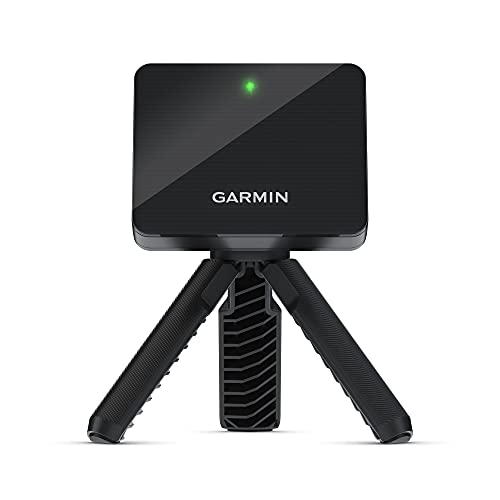
Garmin Approach R10 launch monitor
The Lasso display below supplies the current Amazon image, price, and availability. Verify that the listing includes the R10, magnetic tripod, phone mount, carry case, charging cable, and documentation before ordering.
Our top starter pick for garage golfers with enough depth for a radar-based setup. It is portable, simulator-capable, and a strong value for mat-and-net practice without immediately building a premium simulator bay.
Garmin R10 specs that matter in a garage
| Category | Garmin Information | Why It Matters in a Garage |
|---|---|---|
| Minimum indoor room | 15 ft long × 8 ft wide × 8 ft high | This is a device minimum. Golfer swing clearance, mat height, screen movement, and garage hardware may require more. |
| Monitor position | 6–8 ft directly behind the ball | The area behind the golfer must remain clear and level, which can be difficult in shallow garages. |
| Ball flight | At least 8 ft from tee to net or screen | More space can improve radar observation, especially when indoor spin performance matters. |
| Included hardware | Magnetic tripod, phone mount, carry case, cable, documentation | Useful for a portable setup, but a mat, net, display, and protection are separate. |
| Display | Compatible phone or tablet through Garmin apps | The R10 has no built-in screen. Plan where your phone, tablet, TV, or projector output will go. |
How much room does the Garmin R10 need?
Garmin lists a minimum indoor space of 15 feet long, 8 feet wide, and 8 feet high. Treat that as the launch monitor’s starting point, not a universal simulator-room recommendation. Your golfer, longest club, mat thickness, enclosure, and rear net clearance can require more.
Practical depth is usually more than the simple 14–16-foot radar calculation.
Six to eight feet behind the ball plus eight feet to the net equals 14–16 feet before adding net movement, screen buffer, wall clearance, device protection, or a walking path. Measure the finished setup, not an empty garage floor.
How accurate is the Garmin R10 indoors?
The R10 can provide useful garage practice data when placement, alignment, ball flight, and the radar environment are controlled. Garmin publishes accuracy figures including approximately ±1 mph for ball speed, ±1 degree for launch angle and launch direction, and ±5 yards for carry distance. Those are manufacturer specifications, not a promise that every garage or every shot will fall inside those ranges.
Indoor spin is the bigger limitation. Radar launch monitors observe more ball flight outdoors than they can in a garage. Garmin supports Titleist Pro V1 and Pro V1x RCT balls, which contain radar-reflective technology designed to improve indoor spin and carry-distance performance.
Ball speed and launch
Ball speed, launch angle, and launch direction are useful for gapping, strike-pattern work, and comparing shot groups.
Spin and curvature
RCT balls, enough flight, correct alignment, and a cleaner radar environment can improve indoor spin and shot-shape results.
Setup errors
A unit aimed a few degrees off target can make launch direction and shot shape look wrong even when the monitor is working normally.
What data does the Garmin R10 provide?
Garmin currently describes the R10 as providing more than 15 ball and club metrics. Depending on the app and mode, those include measurements or modeled values such as ball speed, club-head speed, launch angle, launch direction, club path, face angle, angle of attack, spin, carry distance, total distance, apex height, and deviation.
Ball speed
How fast the ball leaves the clubface.
Club-head speed
The estimated speed of the club through impact.
Launch angle
The vertical launch immediately after impact.
Launch direction
The initial horizontal direction relative to target.
Club path
The estimated direction of the club through impact.
Face angle
The estimated face orientation relative to target.
Spin rate
Indoor performance depends heavily on ball flight and RCT-ball use.
Carry distance
The modeled distance before the first landing.
A simple R10 practice session
- Choose one club and hit five warm-up shots.
- Track ball speed, launch angle, carry, and deviation for 10 scored shots.
- Remove obvious misreads instead of chasing a single strange number.
- Change only one swing intention, then compare the next 10-shot group.
- Use dispersion and averages—not the longest shot—to judge improvement.
Garmin R10 software and recurring costs
The R10 pairs with the Garmin Golf app for driving-range sessions, shot data, club statistics, and simulator features. The hardware price does not automatically include every virtual-golf experience. Home Tee Hero requires an active Garmin Golf membership, while third-party platforms have their own subscriptions or licenses.
| Software | What It Adds | Cost Consideration | Best Use |
|---|---|---|---|
| Garmin Golf | Driving range, metrics, shot analysis, club data, and swing video tools | Core app access; some premium features require membership | Practice and launch-monitor workflow |
| Home Tee Hero | More than 43,000 courses, virtual rounds, multiplayer, and practice modes | Active Garmin Golf membership required | Mobile-first virtual golf |
| E6 Connect | Photorealistic simulator software and course options | Separate content, license, or subscription | More polished simulator visuals |
| Awesome Golf | Games, practice challenges, family play, and training modes | Separate subscription or license | Practice variety and multiplayer |
| TGC 2019 | Large course library and user-created course ecosystem | Separate software purchase and compatible computer | Dedicated simulator users wanting extensive course choice |
New standalone Home Tee Hero app
Garmin released a new Home Tee Hero app for R10 users in January 2026 with upgraded graphics, 15 enhanced courses, and an on-course practice mode that lets golfers repeat shots from a selected location.
Choose software before the projector
Confirm the device, operating system, computer, casting method, screen ratio, and ongoing software cost before buying a projector or permanent mount.
How to set up the Garmin R10 in a garage
Build the safe hitting area
Install the net or screen with enough rear buffer, side protection, ceiling clearance, and padding before adding electronics.
Mark the ball position
Keep at least 8 feet from the ball to the net and test full swing clearance from the finished mat height.
Place the R10
Set the monitor 6–8 feet behind the ball on a level, stable surface with the lower edge above the mat.
Align the target line
Use the alignment line and a club or straightedge to aim through the ball toward the center target.
Enter exact distance
When the app asks, enter the measured distance from the launch monitor to the tee instead of estimating.
Validate with wedge shots
Hit controlled straight shots and compare the actual start line with the app before beginning a full session.
What does a Garmin R10 garage setup really cost?
The launch monitor is only one part of the purchase. A safe and useful garage setup also needs ball containment, a hitting surface, a compatible display device, and potentially software, lighting, protection, and a projector.
Best-value R10 build path
Start with the R10, a quality mat, a properly sized net, side protection, and a phone or tablet. Confirm that you enjoy the practice workflow before buying an impact screen, projector, gaming computer, or premium software.
Garmin R10 pros and cons
Pros
- Strong value compared with premium launch monitors
- Small, light, and easy to move between garage and range
- Up to 10 hours of battery life
- More than 15 useful ball and club metrics
- Garmin Golf, Home Tee Hero, and supported third-party software paths
- Works for right- and left-handed golfers without moving a beside-ball unit
- RCT ball support improves the indoor radar workflow
- Can start as a simple net setup and upgrade later
Cons
- Needs 6–8 feet behind the ball plus at least 8 feet to the net
- Indoor spin performance depends on ball flight and RCT-ball use
- Alignment and room interference can create misleading shot shapes
- No built-in screen or standalone display
- Some simulator experiences require additional subscriptions or software
- Not the best choice for a shallow garage
- Projector and PC workflows require more planning than mobile practice
- Premium camera systems can provide stronger short-flight indoor data
When another launch monitor is a better fit
Choose a beside-ball system
A camera or hybrid monitor beside the ball can reduce the space needed behind the golfer and may fit a shorter garage more easily.
Spend more on direct capture
Golfers prioritizing indoor spin, club delivery, and premium simulation may prefer a higher-priced camera or hybrid monitor.
Buy a basic radar instead
If you only need swing speed, ball speed, and carry feedback, a simpler device may cost less and require less software.
This review starts with room fit and total ownership—not the product box.
Golf Garage Guide does not claim hands-on testing unless it has actually occurred. We evaluated the R10 using Garmin’s current product specifications, January 2026 owner’s manual, indoor-placement guidance, radar troubleshooting documentation, software compatibility, RCT-ball information, the 2026 Home Tee Hero update, and the complete equipment a garage golfer still needs.
Related garage golf guides
Official references used for this review
- Garmin Approach R10 official product page
- Garmin Approach R10 owner’s manual, January 2026 edition
- Garmin indoor and outdoor placement guidance
- Garmin radar troubleshooting and interference guidance
- Garmin Titleist RCT ball compatibility guidance
- Garmin January 2026 Home Tee Hero update
- Garmin simulator and subscription compatibility
Garmin Approach R10 review FAQs
Is the Garmin R10 good for a garage golf simulator?
Yes, when the garage provides enough depth and a clean radar environment. Garmin recommends 6–8 feet from the R10 to the ball and at least 8 feet from the ball to the net, plus safe swing and net-clearance space.
How much room does a Garmin R10 need indoors?
Garmin lists a minimum room of 15 feet long, 8 feet wide, and 8 feet high. That does not include every golfer’s swing needs or every net’s rear buffer. Measure from the finished mat and test your longest intended club slowly.
Does the Garmin R10 measure spin indoors?
Indoor spin performance depends on the available ball flight and the ball being used. Garmin supports Titleist Pro V1 and Pro V1x RCT balls, which are designed to improve spin and carry-distance performance with radar launch monitors indoors.
Does the Garmin R10 require a subscription?
The R10 can use the Garmin Golf app for practice features, but Home Tee Hero requires an active Garmin Golf membership. E6 Connect, Awesome Golf, TGC 2019, and other supported platforms have their own costs and compatibility requirements.
Can the Garmin R10 work with a projector?
Yes. Home Tee Hero can be displayed through a compatible mobile casting setup, and compatible third-party software may run through a computer or supported device. Confirm the exact software, operating system, screen ratio, and connection method before mounting a projector.
Is the Garmin R10 good for both right- and left-handed golfers?
Yes. Because the monitor sits behind the ball rather than beside it, players can switch handedness without moving the R10. The hitting bay still needs enough width and centered ball containment for both golfers.
What is the biggest Garmin R10 drawback indoors?
The biggest drawback is the combination of room depth and radar limitations. The R10 needs clear space behind the ball, enough ball flight, careful alignment, and reduced interference. Shallow garages may fit a beside-ball monitor better.
Is the Garmin R10 still worth buying in 2026?
It remains a strong value for golfers who have enough room and want a portable monitor that supports practice, Home Tee Hero, and multiple supported third-party simulator paths. The January 2026 Home Tee Hero update improved its mobile simulation experience.
Buy the Garmin R10 for value and flexibility—not because it fits every garage.
The Approach R10 is a compelling first launch monitor when your garage has the required depth, you want to practice indoors and outdoors, and you prefer an affordable path that can grow from a phone-and-net setup into a projected simulator. Measure the room first, control the radar environment, budget for the complete setup, and consider RCT balls when indoor spin performance matters.