Radar vs Camera Launch Monitors for Indoor Golf
The old “radar or camera?” question is now only the beginning. Modern launch monitors may use radar, photometric cameras, infrared cameras or a hybrid of both. For a garage, the most important differences are where the unit sits, how much ball flight it needs, how it measures spin, whether it supports both handednesses and how easily the setup returns to the same position.
Camera and overhead systems usually save depth; rear radar often improves portability.
A near-ball camera or overhead system is usually the first category to consider when garage depth is limited. A rear radar unit can be a strong value when the room provides the required distance behind the ball and from the ball to the net. Hybrid units combine technologies, but they still follow the placement requirements of their design.
Measure every placement zone before choosing technology.
The room must hold the golfer, full swing, launch monitor, hitting zone, ball-flight zone, containment, display, cables and walking path at the same time.
Radar, camera and hybrid systems solve different tracking problems.
Tracks movement through space
Radar measures motion and is commonly used behind the ball. Indoor performance depends heavily on the model’s required rear distance, ball-flight distance, alignment and spin-measurement method.
Observes impact and early flight
High-speed cameras or infrared optical systems capture the ball and sometimes the club near impact. They can reduce room-depth needs but require a defined view, hitting zone and placement plan.
Combines radar and cameras
Hybrid systems may assign different jobs to each sensor—for example, cameras for ball spin and radar for club delivery. “Hybrid” describes the technology, not one universal room requirement.
Where the monitor sits matters more than the sensor label.
Behind-ball tracking
Keeps the hitting surface open and can support right- and left-handed play without moving the monitor, but consumes room depth and needs protection from feet, storage and traffic.
Near-ball tracking
Uses less depth and can work well in compact rooms, but occupies side space, requires a defined hitting zone and may need repositioning for opposite-handed golfers.
Ceiling-mounted tracking
Keeps equipment off the floor, can provide a larger shared hitting zone and often handles both handednesses well, but requires permanent mounting, power, calibration and ceiling clearance.
Rear-tracking garage layout
Near-ball or overhead garage layout
Three monitors show why “radar vs camera” is too simple.
These are examples of distinct tracking and placement approaches. They are not the only products in each category, and the live Lasso cards should be checked for current availability, pricing and listing details.
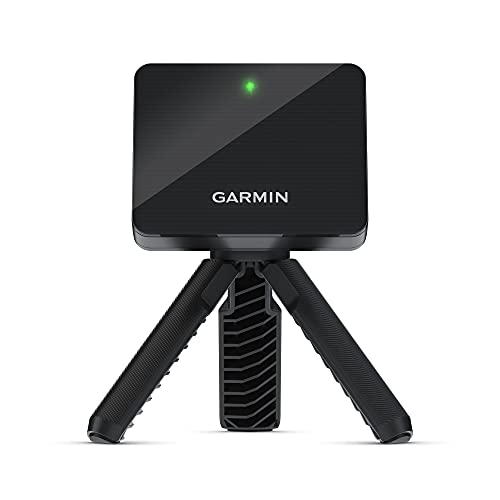
Garmin Approach R10
The R10 illustrates the value and room tradeoff of rear radar. Garmin requires an indoor space at least 15 feet long by 8 feet wide by 8 feet high, places the unit 6–8 feet behind the tee and requires the ball to be at least 8 feet from the net or screen.
Our top starter pick for garage golfers with enough depth for a radar-based setup. It is portable, simulator-capable, and a strong value for mat-and-net practice without immediately building a premium simulator bay.
Best reason to choose it
Portable indoor-and-outdoor use at a lower entry price than many permanent camera and overhead systems.
Main garage constraint
The required rear zone and tracked ball flight consume nearly the complete depth of many single-car garages.
Best room fit
A bay with at least the official minimum dimensions, a protected rear device position and repeatable target-line alignment.
Rapsodo MLM2PRO
The MLM2PRO combines radar and dual-camera technology, yet it still uses a rear-tracking layout. Rapsodo recommends 8 feet from the ball to the net and another 6.5–8.5 feet behind the ball. RPT-patterned balls allow the Impact Vision camera to measure spin rate and spin axis indoors.
A strong choice for golfers who want app-based practice, video feedback, measured shot data, and simulator play. It combines Doppler radar with two cameras and works especially well for golfers who enjoy a mobile-first practice experience.

Why hybrid matters
Radar tracks the shot while the high-speed camera and patterned ball support measured spin and impact video.
Why it still needs depth
The added cameras do not turn it into a near-ball monitor; the unit remains behind the golfer and ball.
Best room fit
A deeper garage with reliable alignment, enough room for full swing video and a willingness to use the required ball pattern for measured spin.
SKYTRAK ST MAX
The ST MAX combines dual Doppler radar with photometric cameras in a compact near-ball design. SKYTRAK recommends at least a 10-foot-wide by 10-foot-deep indoor space, plus enough height to swing safely. The near-ball architecture avoids the long rear-tracking lane required by many radar units.
A premium indoor launch monitor that sits beside the ball, saving the space behind the golfer required by many radar systems. Combines photometric cameras and dual Doppler radar for detailed ball and club data.

Why it changes the comparison
It combines radar and camera data while using the compact placement normally associated with near-ball photometric systems.
Main garage check
Confirm the side position, protected device zone, hitting area and transition plan for right- and left-handed golfers.
Best room fit
A compact dedicated indoor bay where saving rear depth matters more than rear-mounted portability.
Use exact product dimensions—not category averages.
Add two distances
Total tracking depth equals the required monitor-to-ball distance plus the required ball-to-net distance, before adding wall clearance, enclosure depth and safe walking space.
Protect the side zone
Saving depth does not eliminate space planning. The monitor needs side clearance, a defined hitting area and protection from clubs, balls, feet and opposite-handed movement.
Map the ceiling
Confirm mounting height, hitting-zone dimensions, garage-door travel, tracks, opener, lighting, projector placement, power, Ethernet and calibration access.
Ask how spin is captured indoors.
Direct optical spin
Cameras may capture a visible pattern, ball markings or dimples through rotation near impact.
Radar spin
Radar systems may measure spin from tracked movement or use radar-enhancing ball technology indoors.
Patterned balls
Systems such as MLM2PRO use a specific print pattern so the camera can measure spin rate and spin axis.
Calculated spin
Some configurations estimate spin from other measurements. That may be useful, but it is not the same as direct measurement.
Camera systems need visibility; radar systems need a clean tracking environment.
Camera visibility
Follow the manufacturer’s lighting instructions and control glare, deep shadows, direct sunlight, flicker and objects that block the ball or club view.
Radar alignment
Keep the unit level and aligned to the target line. Protect the rear lane from movement, metallic interference, loose cables, fans, vehicles and storage.
Hybrid requirements
A hybrid can inherit the setup sensitivity of both systems. Cameras, radar, marked balls and alignment may each affect different metrics.
Placement determines whether the monitor must move.
Rear tracking
A centered rear monitor can often remain fixed while right- and left-handed golfers use the same target line, assuming the mat and room are wide enough.
Side floor monitor
A device beside the ball may need to be moved when handedness changes, or the golfer may need separate hitting positions.
Overhead monitor
Many overhead systems provide a centered hitting zone that supports both handednesses without moving hardware, but the exact hitting-zone width still matters.
Technology alone does not tell you which metrics are measured.
Ball data first
Carry, ball speed, launch, spin, start direction and dispersion cover most garage-practice goals.
Club data next
Club speed, path, face angle, face-to-path, attack angle and impact location help explain the ball flight.
Check measured vs calculated
A product may measure some metrics directly while calculating or estimating others. The list can change with software tier, ball markings or club stickers.
Tracking technology is only one part of the ecosystem.
Native app
Compare included range tools, practice modes, shot history, video, bag mapping and firmware support.
Third-party software
Confirm official support for GSPro, E6 CONNECT, Awesome Golf or the software you actually plan to use.
Memberships
Add the monitor-company subscription, simulator software, course content and renewal dates.
Host hardware
Include the phone, tablet, Windows PC, graphics card, network, adapters, TV or projector.
Choose the architecture that creates the fewest compromises.
Best when depth and portability matter less than flexibility
- The exact rear and ball-flight distances fit comfortably.
- You want indoor and outdoor practice from one device.
- Right- and left-handed golfers need a centered fixed monitor.
- You can protect the device from feet, vehicles and storage.
- Alignment can return to the same target line every session.
- The spin method and marked-ball requirements fit your practice.
Best when depth and a dedicated indoor workflow matter most
- The garage cannot spare a long tracking zone behind the ball.
- The simulator is primarily or permanently indoors.
- You can protect a side monitor or mount overhead hardware.
- The hitting-zone size fits tee movement and handedness.
- Lighting, power and calibration can remain consistent.
- The measured ball and club data justify the higher system cost.
Radar vs camera vs hybrid launch monitors indoors
| Category | Rear Radar | Near-Ball Camera | Overhead Camera | Hybrid | Garage Takeaway |
|---|---|---|---|---|---|
| Typical placement | Behind the ball | Beside the ball | Above the hitting zone | Rear, side or overhead | Choose placement first |
| Room depth | Often the highest requirement | Usually lower rear-depth requirement | Usually lower rear-depth requirement | Depends on architecture | Verify exact distances |
| Floor space | Rear device zone | Side device and hitting zone | Floor remains clear | Depends on design | Map every danger zone |
| Portability | Often strong | Often strong to moderate | Permanent installation | Varies widely | Match shared-garage workflow |
| Both handednesses | Often easy with centered setup | May require moving the unit | Often easy with wide hitting zone | Placement dependent | Test the complete stance |
| Spin method | Radar, enhanced ball or calculation | Optical pattern, markings or dimples | Optical pattern, markings or dimples | Can combine methods | Ask what is directly measured |
| Environment sensitivity | Alignment, room and tracked flight | Lighting, visibility and hitting zone | Mounting, calibration and visibility | Can inherit both | Control the environment |
| Best fit | Deeper portable indoor/outdoor setup | Compact indoor bay | Permanent shared simulator | Buyer seeking complementary tracking | Room fit decides the winner |
Radar vs camera buying mistakes to avoid
Buying by sensor label
Two radar or camera products can have completely different placement, space and data requirements.
Using total room depth
Subtract wall clearance, enclosure depth, rear storage, device space and safe walking room.
Ignoring marked-ball rules
Confirm which balls or patterns are required for directly measured spin indoors.
Assuming hybrid removes setup needs
Hybrid tracking can still need alignment, lighting, specific balls and a defined hitting zone.
Forgetting handedness
A side monitor that fits one golfer can conflict with the opposite stance or require repositioning.
Ignoring the software ecosystem
Hardware value changes when the required app, membership, gaming PC or simulator software does not fit.
Comparing only metric count
Confirm which metrics are measured, calculated, estimated, included or locked behind another plan.
Leaving the device exposed
Protect rear and side monitors from balls, clubs, feet, vehicles, storage, children, pets and cables.
Skipping a full reset test
Rebuild the complete simulator several times before committing to permanent mounts, turf and cable routes.
Room fit and official documentation came before broad technology claims.
Golf Garage Guide does not claim hands-on testing unless it has actually occurred. This guide uses current manufacturer documentation for tracking technology, placement, indoor dimensions, ball requirements and handedness workflows. The framework prioritizes usable room fit, directly measured data, repeatable setup, safety, software and ownership cost.
Related garage golf guides
Official references used for this update
- Garmin Approach R10 indoor placement requirements
- Rapsodo MLM2PRO tracking technology, room requirements and RPT spin measurement
- SKYTRAK ST MAX dual-radar and photometric-camera technology
- SKYTRAK indoor room recommendations
- Foresight GC3 three-camera photometric tracking example
- Uneekor overhead placement and right-left handed workflow
Radar vs camera launch monitors FAQs
Are radar or camera launch monitors better indoors?
Neither technology is universally better. Near-ball camera and overhead systems often save room depth, while rear radar can offer strong portability and indoor-outdoor use. The exact model and room determine the winner.
Do radar launch monitors need more room?
Many rear radar monitors need space behind the ball plus a minimum amount of ball flight before the net. Some ceiling-mounted hybrid radar systems do not follow that pattern, so check the exact documentation.
Do camera launch monitors need special lighting?
Some optical systems rely on built-in infrared lighting, while others are affected more by room lighting, glare, shadows or direct sunlight. Follow the exact manufacturer guidance rather than using a universal lighting rule.
What is a hybrid launch monitor?
A hybrid uses more than one tracking technology, commonly radar plus high-speed cameras. The sensors may measure different ball or club metrics, but the room requirement still depends on where the unit is installed.
Which type is best for a short garage?
Start with near-ball or overhead systems because they often avoid the long rear tracking lane. Confirm the complete simulator depth, safe screen distance, side clearance, hitting zone and swing space.
Which type is easiest for right- and left-handed golfers?
Centered rear and wide overhead systems often allow both handednesses without moving the monitor. Side-mounted floor units may need repositioning or separate hitting locations.
Are marked golf balls required indoors?
It depends on the monitor and metric. Some systems use RCT, RPT, reflective dots, printed patterns or ordinary clean balls. Confirm what is needed for directly measured spin, spin axis and simulation mode.
Does a hybrid monitor measure everything directly?
Not necessarily. A hybrid can directly measure some metrics and calculate or estimate others. Review the exact measured-data list and any required software or membership tier.
Should I choose the launch monitor or software first?
Choose them together, but room fit and official monitor compatibility are the hard constraints. Confirm the monitor fits, then verify the software, membership and computer requirements.
What should I measure before buying?
Measure ceiling height, room width, total depth, usable rear distance, ball-to-net distance, side clearance, hitting-zone width, swing clearance, garage-door hardware and every equipment danger zone.
Choose placement architecture first, then choose the tracking technology.
Rear radar is compelling when the garage has enough depth and the monitor needs to travel indoors and outdoors. Near-ball camera and overhead systems are compelling when saving depth and creating a dedicated indoor workflow matter most. Hybrid systems can combine strengths, but they do not eliminate room, ball, lighting, software or subscription requirements.